

Here is the thing nobody tells you about layered necklaces. The problem is not the necklace. The problem is the minute you take it off.
I am 61, and I spent most of my life thinking a necklace was one chain, one pendant, done. Then I bought a MEVECCO layered necklace back in May, the kind with two fine chains hanging from a single clasp, and I learned fast that two chains attach themselves to each other the second you look away. Twenty minutes with a straight pin, holding it up to the lamp, trying not to bend anything. I did that twice before I got organized. This is the routine I landed on, and the chain has not knotted since.
The necklace that made me finally learn this: two layers, one clasp
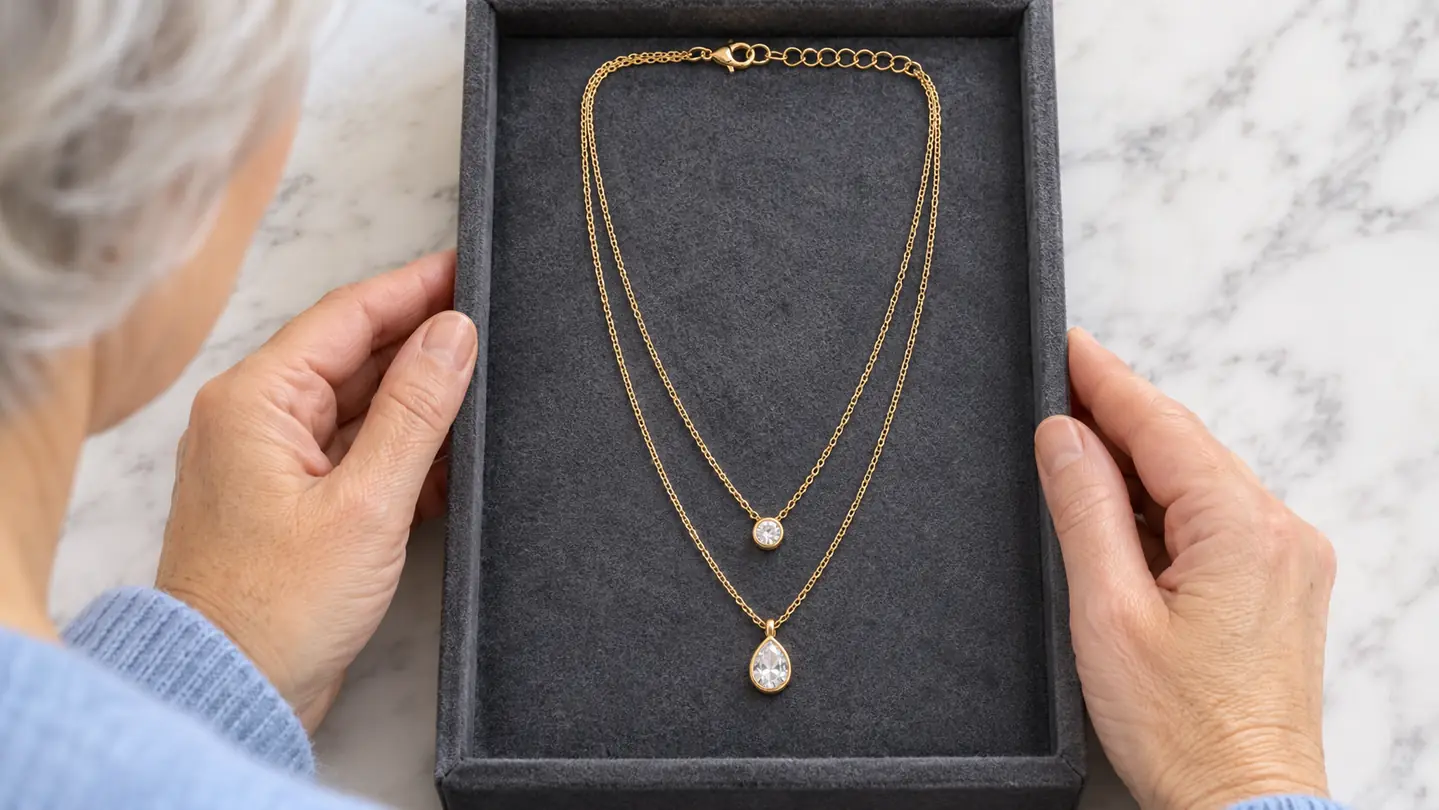
Two fine plated chains on a single lobster claw, so the layering is already done for you. A small pendant and a cubic zirconia stone sit on the lower layer. Brass with yellow gold plating, so keep it dry and it will keep its shine longer.
Amazon See today's price on Amazon →Step 1: Decide your lengths before you buy anything
Layering only looks like layering when the chains land at different heights. If two chains sit within an inch of each other, they read as one chain that got bunched, and they will also tangle more, because they are close enough to brush. Here is how I measured without a jewelry ruler. I took a piece of kitchen string, laid it around my neck at the height I wanted the lower chain to land, and pinched the spot. Then I laid the string flat on the dresser beside a tape measure. Just under eighteen inches. The chain I already had measured about sixteen and a quarter. That inch and three quarters is the gap I keep talking about, and it is the difference between two chains that hang and two chains that fuss at each other all day. Ninety seconds with a piece of string, and I have not guessed at a necklace length since. If you are buying pieces one at a time, write the lengths down before you order. Anything closer than two inches apart is going to crowd.
What actually worked on me: one chain at the hollow of my throat and the next one two to three inches lower, right where a V-neck opens up. That is the gap the MEVECCO set came with already built in, which is a big part of why I stopped fighting with separate chains. The chain I wore alone for years sits higher than both of those and does not play well with either, so it stays in the tray. That is fine. Not every piece wants to be a layer, and forcing one that does not want to be is how people end up with a drawer full of knots.
And I will say the plain thing about single pendants, because I looked at them for years. My daughter Kelly wears one small pendant on a short chain, and it is genuinely pretty on her. It is also the whole necklace by itself. There is no second layer to play off of, and if you add one you are right back to the length question. I judged that necklace on Kelly. I never owned one. If you are still deciding which way to go, that is a different decision than this one, and worth thinking through on its own.
Step 2: Put the heaviest layer on first
Heaviest does not mean heavy. It means the one with the pendant, the stone, the biggest element. Put that on first, closest to the skin, then let the plainer chain sit over it.
The reason is weight. The pendant layer is the one that swings when you lean over the sink or climb into the car. If it is on the bottom and sits close to your body, it moves less and drags the top chain less with it. My kitchen sink sits under a window and I am at it a dozen times a day, rinsing a cup, wiping the counter, leaning in to get the good pan out of the back of the cabinet. Every one of those leans sends a pendant swinging if the pendant is the loose one on top. Worn underneath, close to the skin, mine moves maybe an inch and settles back. When I had it the other way around, the pendant chain threw itself over the top chain every single time I reached across the table at lunch. Swap the layers and you will feel it in your collarbone by two o'clock.
On the MEVECCO, the two layers come already attached to one lobster claw, so this step is done for you. The pendant layer falls where it falls, and the plain layer sits above it. I just have to make sure the clasp is centered at the back of my neck and has not crept around to the side, because an off-center clasp pulls one layer short and the whole thing twists.
Step 3: Fasten it in front, then turn it
This is the step that ended my knot problem, and it took me a shamefully long time to figure out. Do not try to fasten a fine chain behind your head with your hands over your shoulders. You cannot see what you are doing, the clasp is tiny, and if you fumble it the two layers swing forward and cross. The first Sunday I wore mine to church, I fastened it behind my head in the bathroom because Walt was already in the car and I was late. I did it by feel, which is a bad idea with a clasp that small. The layers came over my shoulders crossed, and because they are joined at one claw, a cross at the back becomes an X at the front. I sat through the whole service with one hand up at my collar. There is also no good way to see the back of your own neck without two mirrors, and a bathroom mirror is not two mirrors. That was the last time I did it that way.
Instead, hook the lobster claw with the necklace hanging in front of you, down at your waist, where you can see both layers lying flat and separate. Check that nothing is crossed. Then lift the closed necklace over your head and settle it onto your neck.
Two seconds of checking in front saves twenty minutes of picking at a knot in a mirror. The clasp on mine is genuinely small, small enough that I do this at the dresser with my glasses on, not in the bathroom in a hurry.
Step 4: Keep the clasp at the back and the pendant centered
Once it is on, put one finger at the front of your throat and give the whole necklace a gentle half turn each way until the pendant sits where you want it. If the clasp has slid toward your shoulder, the layers go crooked and the shorter chain starts climbing over the longer one. A cardigan collar will do the same thing if you put the necklace on before the sweater instead of after, which I got wrong for the better part of a month.
I check this in the mirror before I leave the bedroom, every time, and I check it again in the car mirror. It is not vanity. A two-layer necklace that has rotated is a two-layer necklace that is about to twist.
One more thing for the day itself: a scarf, a high collar, or a shoulder bag strap that sits right on your collarbone will all push the layers into each other. The seatbelt is the worst of them, because you do not notice it until you are already down the road. If I am carrying a tote with a wide strap, I tuck the necklace inside the neckline or I leave it off entirely. Not worth the fight.
Step 5: Take it off first and lay it down straight
Everybody I know who has a tangled necklace problem has the same habit. They take it off last, after the earrings, after the bracelet, and they drop it on the dresser while they are still walking.
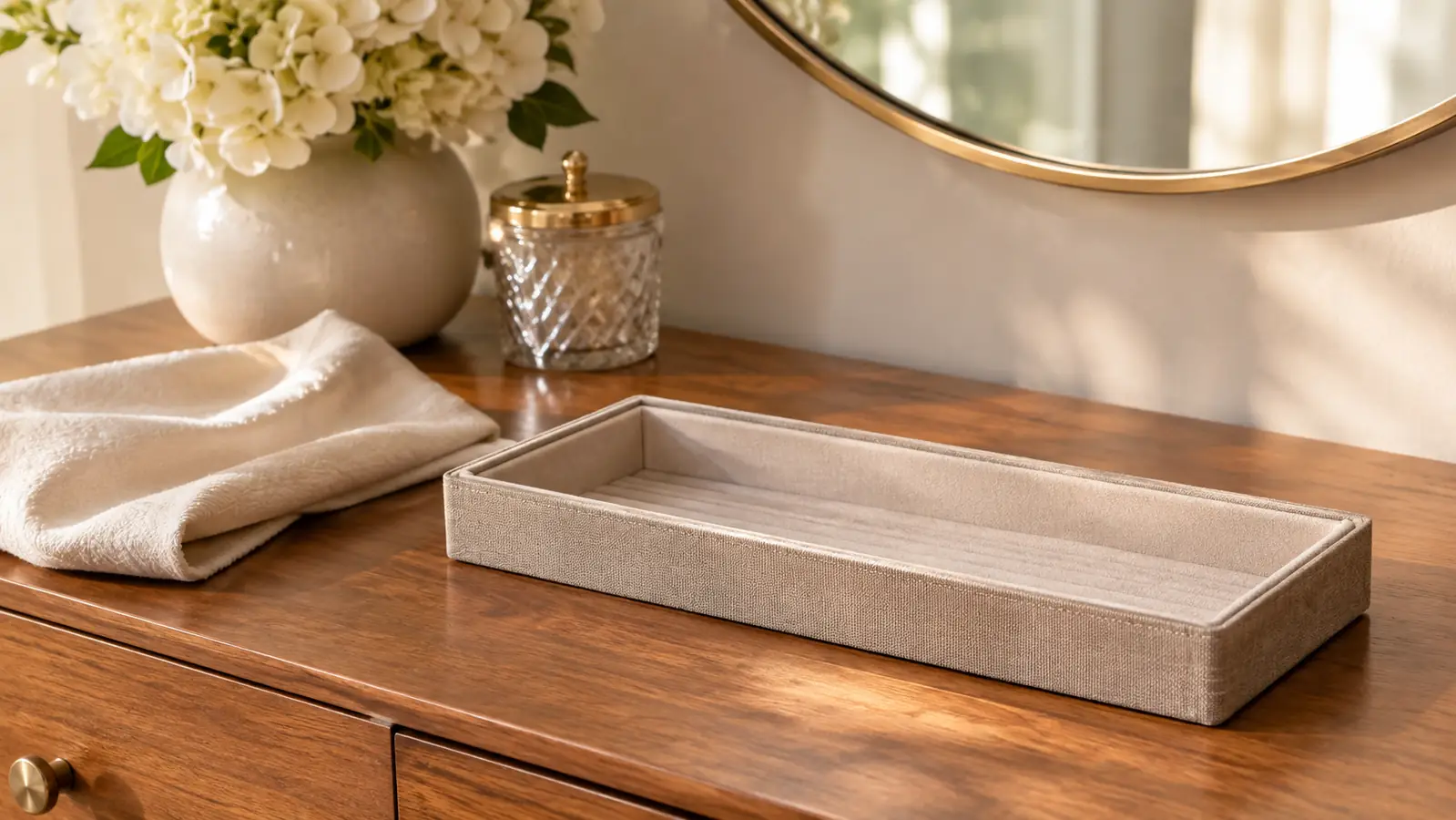
Take the necklace off first. Unhook it. Lay it in one long compartment of a lined tray with both layers running parallel and the chain straight, clasp closed. The tray in my top dresser drawer is the plain lined kind with small square sections down one side and one long section across the top. The MEVECCO necklace takes the long section. The pearl studs get their own little soft pouch inside the tray, because pearls scratch if you look at them wrong. The bracelet and the rings each have a square, and each of my pieces has its own spot so nothing gets piled on top of anything else. Six months of that drawer, and the closures and the chain have stayed where I put them. Walt's sock drawer is the one below and he has never once put anything in mine, which I mention because that is the kind of thing that quietly ruins a jewelry tray.
The clasp closed part matters. A closed necklace stays a loop. An open one finds the next chain in the tray and marries it overnight. I found that out the ordinary way. And take it off before the shower, before bed, before you pull weeds or scrub a sink. Plated brass does not enjoy water, and a wet chain curls and grabs.
Two seconds of checking the clasp in front of me saves twenty minutes of picking at a knot in a mirror. That is the whole trick.
What Else Helps
A few small habits, none of them expensive.
Jewelry goes on last in the morning, after lotion, hairspray and perfume have dried. All three of those leave a film on plated metal, and a tacky chain is a chain that sticks to its neighbor. The order in this house is shower, lotion, hair, clothes, jewelry, and I do it in that order every single morning now. If I put the necklace on before a sweater, the neckline drags it half around my neck and I have to start over. Sounds obvious written down. I got it wrong for a month.
Wipe each piece with a soft dry cloth when you take it off. No dips, no polish, no toothpaste, no ultrasonic machine. I keep one soft cloth folded in the tray and it takes ten seconds. August in Marietta is the real test, because the air is thick enough to drink and plated metal picks up that damp along with everything else. On the worst days I take the necklace off the minute I am in the door and wipe it before it goes in the tray, since a chain that has been against a damp neck all afternoon will hold onto the moisture. I do not keep the tray in the bathroom, either. Steam is not a friend to plating.
If you are layering three chains rather than two, keep the middle one plain and let the pendant layer and the top layer do the talking. Three textured chains together is where most people give up and put them all back in the drawer.
And give the whole setup a realistic expectation. Plated brass is plated brass. I keep mine dry and I do not expect it to look new forever. Six months in, mine still looks the way I want it to, and the reason is mostly the dry-and-straight routine, not luck. If you want to see how the two-layer style held up over a longer stretch, I wrote about daily wear separately, and I also compared a layered set against a single pendant for anyone still deciding which way to go.
Last thing, and I mean this kindly. A tangle that has already happened is usually a sign the necklace went into the tray wrong, not that the necklace is bad. Fix the habit and the knots stop.
One clasp, two layers, no assembly required tomorrow morning
Both chains hang from a single lobster claw, so the lengths are already right and there is nothing to line up while you are half awake. Brass with a yellow gold plated finish. Keep it dry, lay it straight, and it holds up.
Amazon Check today's price on Amazon →